Let the Land Drink: Ancient Water Tricks That Are Saving Modern American Farms
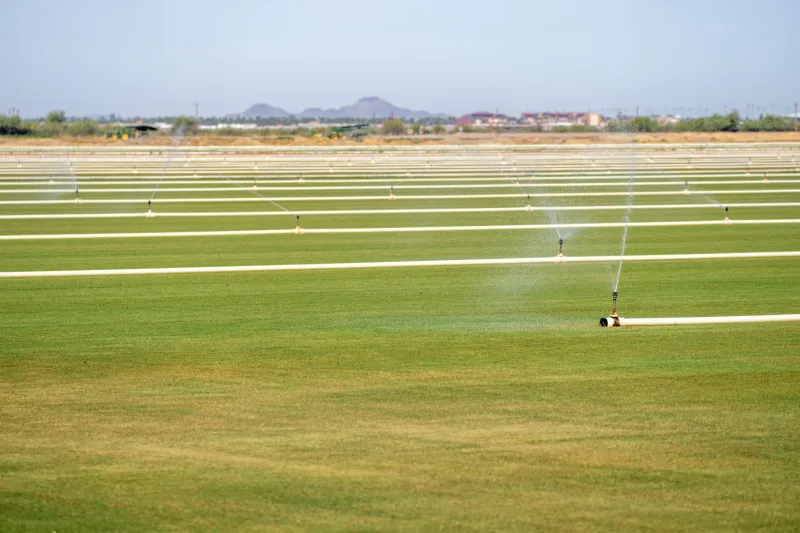
The Ogallala Aquifer is running out of water. That sentence, repeated in agricultural policy circles for two decades, has finally started hitting differently now that it's showing up in farmers' well reports and crop insurance claims across eight states. In parts of Kansas and Texas, the water table has dropped more than 150 feet since large-scale irrigation began in the mid-20th century. In some places, it's effectively gone.
And yet, just a few hundred miles away, there are farms that have never relied on the Ogallala. Farms that have been watering crops with gravity, topography, and patience for generations. Farms that look at a rainfall forecast and see infrastructure, not just weather.
The gap between those two approaches — between extraction and retention — is the central water story of American agriculture right now.
How We Got Here: The Extraction Model
For most of the 20th century, cheap energy and abundant groundwater made deep-well irrigation seem like a permanent solution to the West's aridity problem. Center-pivot systems — those iconic circular green fields visible from any commercial flight over the Plains — transformed millions of acres of semi-arid grassland into productive farmland. Yields soared. Exports boomed.
What wasn't accounted for was the withdrawal rate versus the recharge rate. The Ogallala refills at roughly half an inch per year in some areas. Irrigation has been pulling it down by a foot or more annually in heavy-use zones. The math was always going to catch up eventually.
Water costs are rising everywhere. In California's Central Valley, water districts are pricing allocations at levels that would have seemed absurd twenty years ago. In the Southwest, Colorado River compact negotiations are reshaping what's legally available for agricultural use. Even in traditionally water-rich states like Indiana and Illinois, drought years are becoming more frequent and more severe.
The farmers who are weathering this best are the ones who figured out — or rediscovered — how to make every drop of rain count.
Swales: The Oldest Infrastructure in Agriculture
A swale is, at its simplest, a level trench dug along the contour of a slope. When rain falls, instead of running downhill and carrying topsoil with it, water flows into the swale and spreads horizontally across the landscape. It slows down. It sinks in. The land drinks.
This technique is ancient — versions of it appear in pre-Columbian Andean agriculture, in traditional West African farming systems, and in the field practices of Indigenous peoples across the American Southwest. It doesn't require electricity, pumps, or any ongoing input beyond the initial earthwork.
On a practical level, a well-designed swale system on a 5-acre property can capture and infiltrate several thousand gallons of water from a single inch of rainfall that would otherwise run off. Over a season, that's the difference between stressed plants and thriving ones in a dry year.
Randy Okafor, who runs a diversified vegetable and livestock operation in the Texas Hill Country, installed a series of swales across his 80-acre property four years ago using a rented excavator and a basic laser level. "That first real drought year after I put them in, my neighbor was hauling water," he says. "I wasn't. My pastures stayed green two weeks longer than anything around me."
Contour Farming: Reading the Land Before You Plow
Contour farming means aligning tillage, planting rows, and field operations along the natural contour lines of a slope rather than running straight up and down the hill. It sounds simple because it is — but its impact on water retention and erosion is significant.
The USDA's own research has documented that contour farming can reduce water runoff by 50% and soil erosion by up to 64% compared to up-and-down-slope tillage. It was widely promoted by the Soil Conservation Service after the Dust Bowl, fell out of fashion as fields got larger and equipment got wider, and is now making a comeback among farmers who've watched their topsoil — and their water — disappear.
For small-scale growers and homesteaders, implementing contour principles requires nothing more than a simple A-frame level (easily built from scrap lumber for under $20) to identify true contour lines before you lay out your beds.
Drip Irrigation: The Technology That Got Old Enough to Be Wisdom
Drip irrigation isn't ancient — it was developed in Israel in the 1960s — but by the standards of American agricultural technology adoption, it might as well be a heritage technique. Despite decades of evidence showing water savings of 30–50% compared to overhead sprinkler systems, drip remains dramatically underutilized in US vegetable and specialty crop production.
The economics have shifted considerably in recent years. The cost of drip tape and emitter systems has dropped. Water costs have risen. The calculation now clearly favors drip in almost any context where water is either scarce or expensive — which increasingly means everywhere.
For home gardeners, subsurface drip systems can be installed in a weekend for a few hundred dollars and will cut outdoor water use dramatically. The water goes directly to the root zone. Evaporation is minimal. Weed pressure is reduced because the soil surface stays dry. It's one of the highest-return water investments a small-scale grower can make.
Rainwater Harvesting: Catching What Falls on Your Roof
This one gets complicated by state law — yes, some Western states have historically restricted rainwater collection, though most have loosened those rules in recent years. Colorado, which once had some of the strictest limits, now allows residential collection up to 110 gallons. Texas actively encourages it with tax incentives.
A 1,500-square-foot roof in a region that gets 20 inches of annual rainfall can theoretically capture around 18,000 gallons per year. Even capturing a fraction of that in a properly sized tank system meaningfully reduces dependence on municipal water or well draws for garden irrigation.
Randy Okafor has two 5,000-gallon poly tanks plumbed to his barn roof. They fill during spring rains and carry him through most of his summer irrigation needs for a half-acre kitchen garden. "My water bill is basically zero for the garden," he says. "And the plants prefer it — no chlorine, right temperature."
A Simple Starting Framework for Homesteaders
If you're looking to start applying water-retention principles to your own land — whether that's a quarter-acre backyard or a small farm — here's a practical sequence:
- Observe before you dig. Spend one good rain event watching where water flows on your property. Where does it pool? Where does it run off? Where does it disappear fastest? That observation is your design.
- Start with mulch. Heavy mulching in garden beds (4–6 inches of wood chips or straw) is the lowest-cost, highest-impact water retention move you can make. It slows evaporation dramatically.
- Install one swale. Pick the most obvious runoff pathway on your property and dig a simple level trench across it. See what happens over a season.
- Switch one bed to drip. Start with your most water-intensive plants — tomatoes, squash, peppers — and run a simple drip line. Compare your watering frequency to the overhead-irrigated beds.
- Catch some rain. Even a single 50-gallon barrel under a downspout is a start. Scale from there.
The water crisis facing American agriculture isn't going to be solved by any single technology. But the farms that will still be farming in fifty years are the ones learning, right now, to work with what falls from the sky — and to keep it in the ground long enough to matter.