Betting on the Old Breeds: How Heritage Livestock Is Quietly Challenging Industrial Agriculture
Walk into any conventional grocery store and the meat case tells a pretty simple story: rows of shrink-wrapped packages, uniform cuts, consistent color, predictable price. What it doesn't tell you is that the chicken in that package is almost certainly a Cornish Cross — a bird genetically selected to grow to market weight in about six weeks, often unable to support its own body weight by the end of its short life. The pork beside it? Likely from a Landrace or Yorkshire cross, engineered for leanness and rapid gain in confinement.
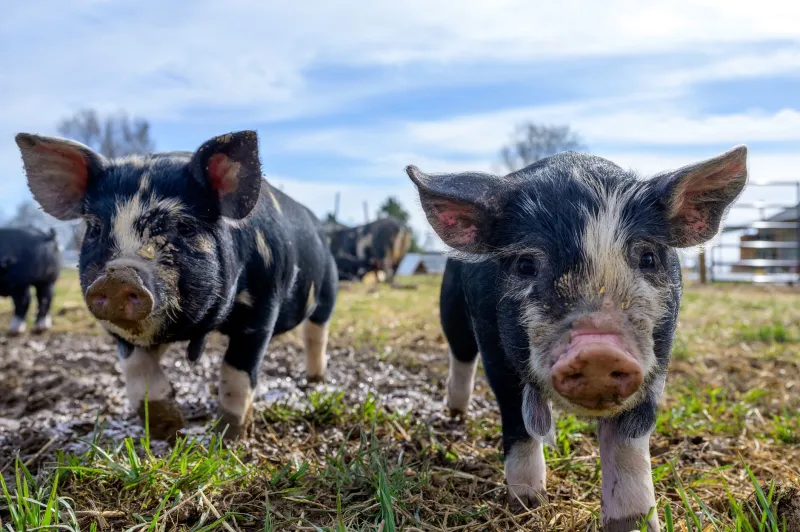
Now drive an hour outside most mid-sized American cities and you might find something completely different. Small farmers are raising Ossabaw Island hogs, American Milking Devons, Narragansett turkeys, and Dominique chickens — breeds with names most consumers have never heard, animals that take twice as long to reach market and cost significantly more to raise. And somehow, these farmers are finding not just customers, but devoted ones.
So what's actually going on here, and why should the average American eater care?
The Industrial Logic — and Its Limits
Big agriculture's move toward genetic uniformity wasn't born from malice. It was born from economics. Standardized animals produce predictable yields, which makes everything from feed contracts to processing logistics easier to manage at scale. When you're moving millions of birds through a facility, consistency is king.
But that logic has a shadow side. Consolidation has narrowed the genetic diversity of our food animals to a startling degree. According to the Livestock Conservancy, dozens of heritage breeds are now listed as threatened or critical — meaning fewer than a few thousand breeding animals exist in the entire country. Once those genetics are gone, they're gone. That's not just a sentimental loss. It's a biological risk.
Genetic monocultures are vulnerable. A single pathogen that adapts to one strain of industrial chicken can move through a flock of millions. We've seen it happen with avian influenza outbreaks that wiped out tens of millions of birds in a single season. Heritage breeds, shaped by centuries of natural selection across diverse environments, often carry broader immune resilience — a kind of genetic insurance policy that industrial strains have largely traded away.
The Farmers Taking the Long Bet
Marco Delgado raises Red Wattle hogs on a small operation in central Tennessee. He came to heritage breeds after years working in conventional pork production and finding himself increasingly uncomfortable with what he was seeing — both in animal welfare and in the flavor of the end product.
"Red Wattles take about twice as long to finish as a commercial hog," he says. "That's twice the feed, twice the labor, twice everything. But the fat marbling is completely different. The flavor is completely different. People who eat it once don't want to go back."
That flavor difference isn't marketing. It's biochemistry. Heritage breeds tend to develop more intramuscular fat — the kind that bastes the meat from within during cooking — partly because they're allowed to grow slowly and often have access to pasture. Studies have also found higher concentrations of omega-3 fatty acids and fat-soluble vitamins in pasture-raised heritage animals compared to their confinement counterparts. You're not just buying a story. You're buying a genuinely different product.
In Vermont, Sarah and Tom Whitfield raise Bourbon Red turkeys, a breed that nearly disappeared in the mid-20th century as the Broad-Breasted White took over the commercial market. Their birds spend months on pasture, foraging alongside their grain ration.
"The Broad-Breasted White can't even reproduce naturally," Sarah explains. "It's been selected so heavily for breast meat that it can't mate. Every single commercial turkey in America is the product of artificial insemination. That's how far we've taken it."
The Whitfields sell out their Thanksgiving birds by August every year.
The Environmental Angle Nobody's Talking About Enough
Heritage breeds aren't just about flavor or animal welfare — though both matter. They're also part of a broader ecological argument about how we raise food.
Many heritage breeds are what farmers call "easy keepers" — animals adapted to thrive on lower-quality forage, in variable climates, without the pharmaceutical inputs that industrial systems depend on. An Ossabaw hog can get a significant portion of its diet from rooting and foraging. A Devon cow is built for grass, not grain. These aren't just charming old-fashioned traits; they're features that reduce the resource intensity of meat production.
When heritage animals are raised on well-managed pasture, they become part of a nutrient cycling system rather than a waste problem. Their manure feeds the soil, the soil grows the grass, the grass feeds the animals. It's not perfect, and it doesn't scale to feed 330 million people on its own — nobody serious is claiming otherwise. But as one piece of a more diversified food system, it points toward something more resilient than what we've built.
What You Can Actually Do With This Information
The honest answer is that heritage breed meat is more expensive, and not everyone has equal access to it. That's a real tension, and it deserves acknowledgment rather than hand-waving.
But there are entry points that don't require a complete overhaul of your grocery budget. Farmers markets in most metro areas now include at least one or two small-scale livestock producers. Community-supported agriculture (CSA) programs increasingly offer meat shares alongside vegetables. Buying a whole or half animal directly from a farmer — called buying "in the box" — is often more economical per pound than buying retail cuts, and it builds a direct relationship with the person raising your food.
You can also look for the American Livestock Breeds Conservancy's approved breed list when shopping online or at specialty butchers. Organizations like Heritage Foods USA have spent two decades building supply chains that connect small heritage breed farmers with consumers across the country.
The industrial system will keep going bigger because that's what its incentives reward. But every dollar that flows toward a small farmer raising a Red Wattle hog or a Bourbon Red turkey is a vote for a different kind of agriculture — one that values genetic diversity, animal welfare, and flavor alongside efficiency.
That's not a small thing. That's exactly the kind of market signal that keeps old breeds alive and small farms viable.
And if you've ever tasted the difference, you already know it's worth it.